A search for a custom printed table runner actually covers two very different products, and picking the wrong size usually comes from not noticing which one you are buying. One is a promotional display runner that drapes down the front of a trade-show or event table to show a logo. The other is a decorative runner that lies down the center of a dining or banquet table. They use different widths, different lengths, and different fabrics, so the sizing rules do not transfer between them. Here is how to get each one right.
The two products hiding behind one search
The display runner is essentially a narrow, printed table cover. It hangs over the front edge of a rectangular table so attendees see your branding from across a hall, and it is almost always full-color polyester made for repeated event use. The decorative runner is a strip of fabric that sits centered across a table for a wedding, holiday, or home setting, framing a centerpiece rather than advertising anything. Deciding which job the runner is doing tells you which sizing section below applies, so start there before you look at any size chart.
Sizing a printed runner for trade-show and event tables
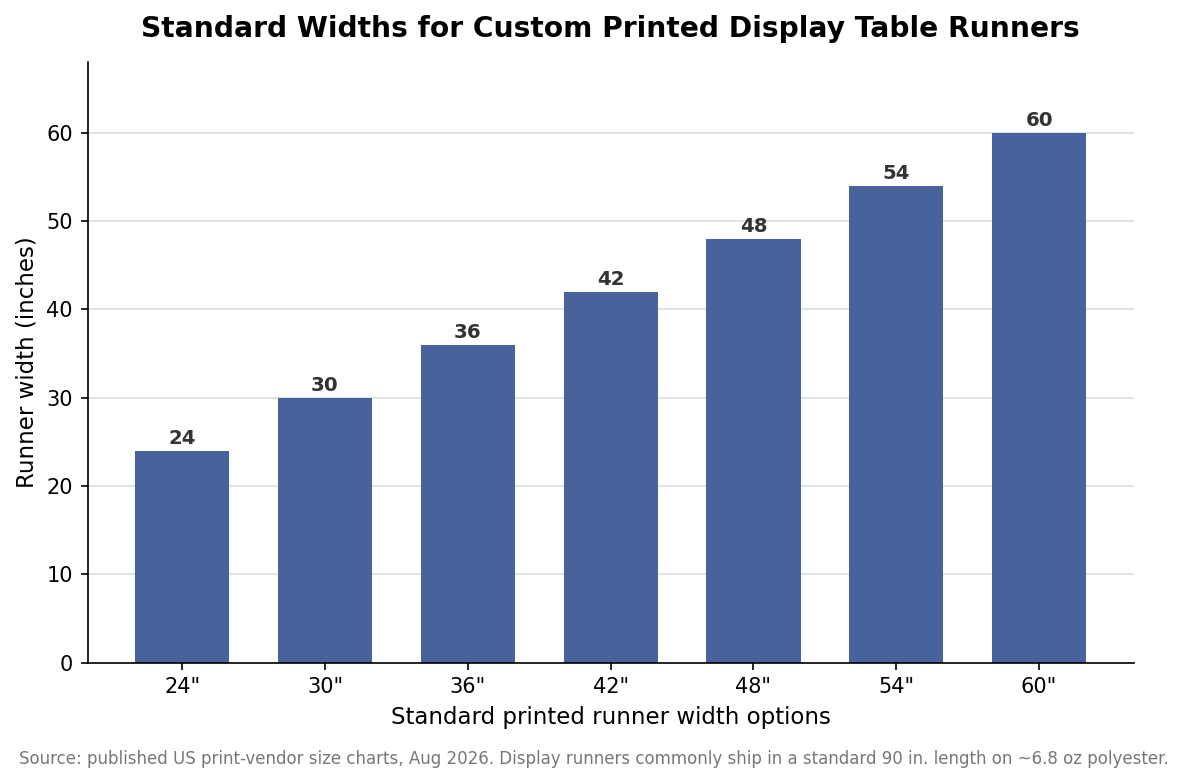
Standard trade-show tables come in two lengths: the 6-foot table at 72 inches and the 8-foot table at 96 inches, both roughly 30 inches tall and 24 to 30 inches deep. Printed display runners are sold by width, and the common options run 24, 30, 36, 42, 48, 54 and 60 inches, typically on a standard length near 90 inches. A narrower 24 to 30-inch runner reads as a clean vertical banner down the front of the table, while a 48 to 60-inch runner behaves more like a partial throw that covers most of the front face. The 90-inch length is what lets the fabric run up and over the tabletop and hang down the front, so the choice you are really making is width, driven by how much of the front you want branded.
If you want the whole table covered rather than a strip, you have crossed over into table throw or fitted-cover territory, which is a different product; a runner is meant to leave some of the table or an underlying cloth visible. For a shared booth where two exhibitors split one 8-foot table, two 30-inch runners often read more clearly than one wide throw. One more thing to check is how far the runner drops toward the floor at the front, since a standard 90-inch runner on a 30-inch-tall table leaves the branded panel hanging well down the front rather than stopping at the tabletop edge.
Sizing a decorative runner for dining and banquet tables
Decorative runners follow proportion rules instead of table-cover logic. Width usually lands between 14 and 20 inches, and a reliable guide is roughly one-third of the table’s width, so a 36-inch-wide table pairs naturally with a runner around 12 to 14 inches. Go much wider and the runner starts to behave like a table cloth; go much narrower and a centerpiece will hide it.
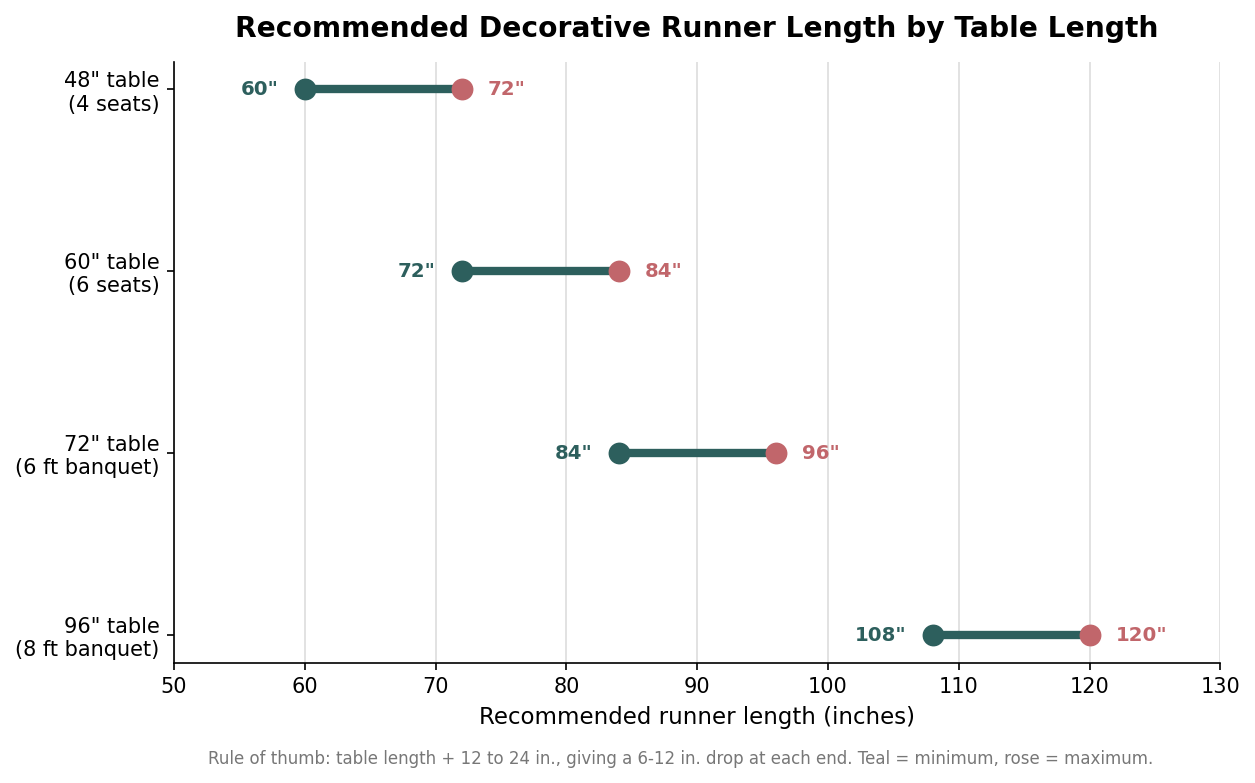
Length is the part people most often get wrong. The rule is table length plus 12 to 24 inches, which leaves a 6 to 12-inch drop at each end for that finished, draped look. A 60-inch six-seat table therefore wants a runner somewhere between 72 and 84 inches, and a 96-inch banquet table wants roughly 108 to 120 inches. If you prefer the runner to stop flush at the table edge with no overhang, match the length to the table exactly, but the small drop generally looks more deliberate.
Fabric and print method: why polyester and sublimation dominate
Most custom printed runners, especially display runners, are woven polyester in the range of about 6.8 ounces per square yard. Polyester is the workhorse here for a specific reason: it accepts dye-sublimation, a process that turns the dye into a gas and bonds it into the fibers rather than laying ink on the surface. That is why a well-made runner prints in unlimited full color with photographic detail, resists cracking and fading, and stays machine-washable and reusable across many events. It is also why cotton and linen runners, which cannot be sublimated the same way, are usually reserved for decorative pieces decorated with embroidery, applique, or a monogram instead of a full-bleed print.
The practical takeaway is to match method to artwork. If your design is a full-color logo, a gradient, or a photo, specify sublimated polyester. If it is a name, monogram, or simple motif on a natural-fabric decorative runner, embroidery will look richer than trying to print it. It is also worth confirming whether the runner is printed on one side or both, because a double-sided print costs more but matters when the back of the table is visible to passers-by.
Minimums, cost, and turnaround
Custom runners are a low-commitment print product. Minimums are often a single unit, which suits a one-table exhibitor or a single event. Indicative published pricing for a full-color sublimated display runner starts in the range of roughly $50 or more for one piece and falls per unit as quantity rises, with the exact figure depending on width, single versus double-sided printing, and fabric. Treat those numbers as a starting point and get a quote against your real dimensions and artwork.
Production is quick: many vendors quote around 5 business days to print and finish, before shipping. Because a runner is often the visible centerpiece of a booth, order early enough to see a digital proof and, ideally, a physical sample before a major show, and confirm the finished dimensions in writing so the runner you receive actually fits the table you are dressing.