Two custom table runners can carry the same logo and cost within a dollar of each other, yet one looks crisp and drapes cleanly at a trade show while the other reads dull, wrinkles at the fold, and gets turned away by a venue for lacking a fire rating. The difference is almost never the artwork. It is the fabric, the print process, and a compliance detail most first-time buyers do not know to ask about. This is a materials guide to those choices, so the runner you order behaves the way you expect on the day.
Why almost every printed runner is polyester
If you want a full-color, edge-to-edge design, the fabric decision is largely made for you: it will be polyester. The dominant printing method for custom runners is dye-sublimation, a process that turns solid dye into gas under heat and bonds it directly into synthetic fibers. That bond is what gives sublimated prints their photographic sharpness and their resistance to cracking or peeling, because the color becomes part of the fiber rather than sitting on top of it. The catch is chemistry: sublimation bonds to polyester and will not take on cotton. So the moment you commit to an all-over printed runner, you are almost certainly committing to a polyester base, whether woven poplin or a knit table-throw fabric.
The fabric ladder, from poplin to canvas
Within polyester and related event fabrics there is a real ladder of weights, and weight changes both how a runner prints and how it hangs. Lighter woven poplin is the trade-show default; it prints cleanly, packs small, and is inexpensive, but it is also the most prone to looking flat and showing creases. As you move up in weight, the fabric drapes with more body, resists wrinkles better, and feels more premium, at the cost of price and packed bulk.
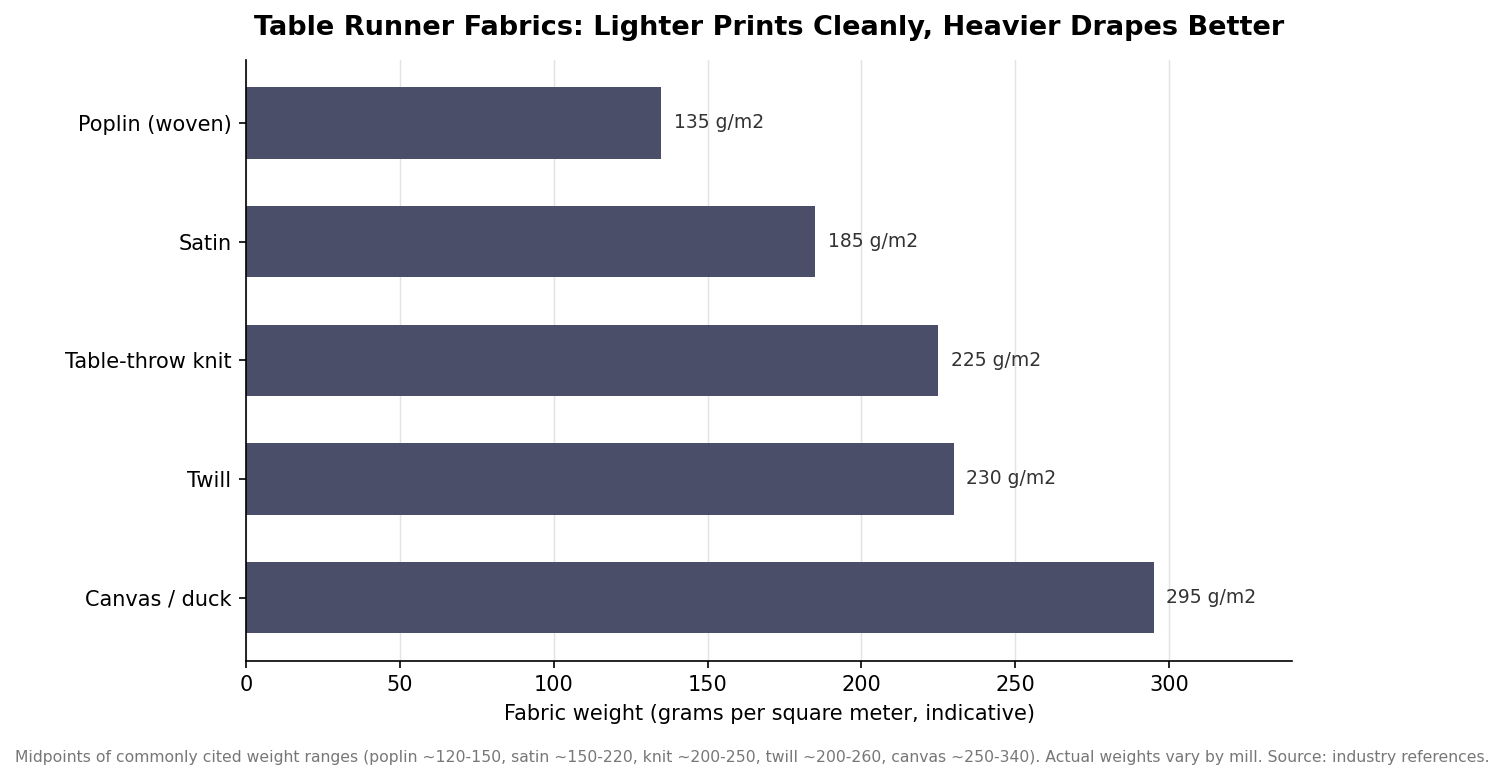
The chart shows indicative weights for the common options. A woven poplin around 130 grams per square meter is the workhorse for exhibitor tables. A polyester knit table-throw fabric in the low 200s has more stretch and lies flatter over a table edge. Satin adds sheen for hospitality and retail settings. Twill and canvas, up toward 250 to 340 grams, give the heaviest drape and the most upscale hand, which suits permanent restaurant or boutique use more than a fold-and-fly trade-show kit. These figures are midpoints of commonly cited ranges rather than mill-exact specs, so use them to compare options, not as a purchase guarantee.
What dye-sublimation can and cannot do
Sublimation’s strengths are vivid, durable, full-bleed color and the ability to print a photograph, a gradient, or a pattern across the entire surface with no added cost per color. That makes it ideal for brand-heavy runners where the whole cloth is the canvas. Its limits are worth knowing too. Because color is dyed into the fibers, very light or white areas are simply the base fabric showing through, so a bright white in your design depends on a bright white blank. Fine, hairline text can soften slightly as dye migrates into the weave, so give small type a little extra weight. And color on a textured knit will look marginally less snappy than the same file on a smooth woven poplin, which is one more reason fabric and artwork should be chosen together.
Care follows from the process. Sublimated polyester runners are generally machine washable in cool water with a synthetic detergent and a low tumble dry, and they are wrinkle-resistant rather than wrinkle-free. Bleach and fabric softeners are best avoided, and pulling the runner from the dryer promptly helps preserve a pressed look. None of this is demanding, but it does assume polyester; it is another reason the material and the print method travel together.
Flame retardancy is not optional at most venues
Here is the detail that catches exhibitors out. Most convention centers, hotels, and public-assembly venues require that table linens and drapes meet a flame-resistance standard, most commonly NFPA 701 in the United States. The test burns fabric samples and measures flame spread, char length, and flaming residue; fabric that passes on all three is certified flame resistant. Many venues can refuse to let you set up, or ask you to remove non-compliant textiles, if you cannot show compliance.
There are two ways a runner meets the standard, and the difference matters over time. Inherently flame-retardant polyester has the property built into the fiber, so it survives washing and stays compliant. Topically treated fabric has a chemical applied after the fact, which can diminish with repeated laundering and may eventually need retreatment or recertification. Whichever you buy, request a Certificate of Flame Retardancy at the time you order, keep it with your booth kit, and be ready to present it, because venues increasingly ask for the document rather than taking a label’s word for it. Confirm the exact standard your specific venue names, since requirements vary.
Sizing the drop so the runner hangs right
Fabric choice and fit interact, because a heavier fabric rewards a longer drop with a cleaner hang while a light poplin can look limp if it pools. For a full-length lay, the geometry is simple: the runner needs to span the table plus an equal overhang at each end, so the length you order is the table length plus twice the drop you want.
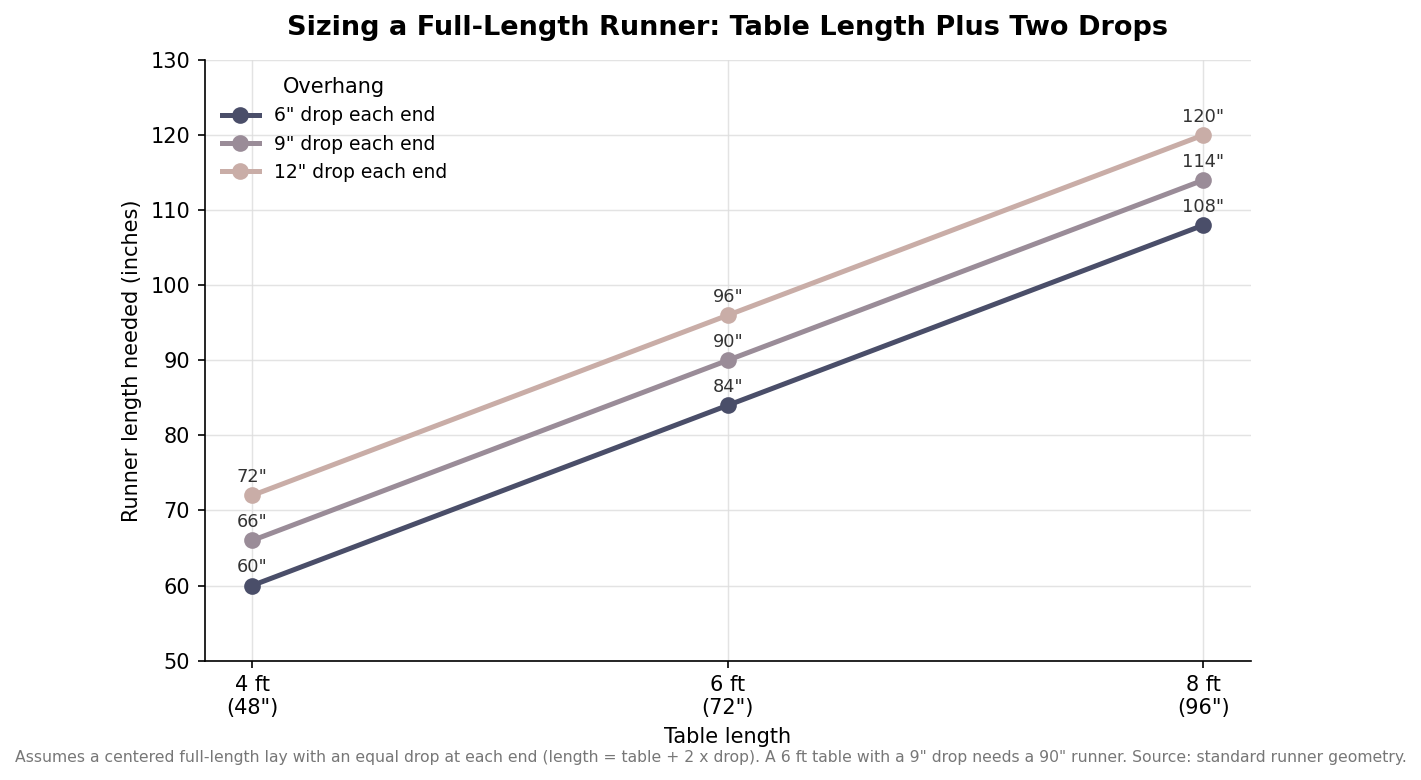
The chart translates that into the sizes you will actually order. A six-foot table with a modest nine-inch drop at each end calls for a ninety-inch runner, which is why lengths like sixty, seventy-two, eighty-four, and ninety inches are so commonly stocked. Decide the drop first based on the look you want and how much branding you want visible on the ends, then size up the length; a heavier twill or canvas can carry a twelve-inch drop with authority, while a light poplin often looks best with a shorter, crisper overhang. Production for printed polyester runners is typically quick, often around three business days after proof approval with rush options available, so the constraint is usually your decision timeline, not the factory’s. Treat the weights, standards, and dimensions here as indicative planning figures and confirm the specifics against a real quote and your venue’s rules before you commit.